Penny wise, megaton destructive
Oct. 28th, 2019 10:43 am![[personal profile]](https://www.dreamwidth.org/img/silk/identity/user.png) swan_tower
swan_towerOur household of three people has at present ballooned to six people and four cats, courtesy of Pacific Gas and Electric.
I don’t know how this is being reported elsewhere in the country (or elsewhere in the world), so I want to be clear about what’s going on. There are multiple causes for California’s wildfire problem, ranging from climate change to flawed forest management policy in past decades to the expansion of settlement into at-risk terrain. But part of it, especially here in northern California, is the direct fault of our electrical companies.
PG&E has, for years, prioritized making massive payouts to their shareholders over investing in basic maintenance and safety. The equipment that started last year’s devastating Camp Fire — the most destructive in the state’s history, the fire that destroyed the town of Paradise — was built in the early 1900s. It was over a hundred years old. PG&E knew damn well their equipment was out of date and in need of refurbishment or outright replacement. But doing that cuts into the quarterly profits, so it got put off, and put off, and put off — until there was nothing left to replace, because it had all been destroyed by the fire.
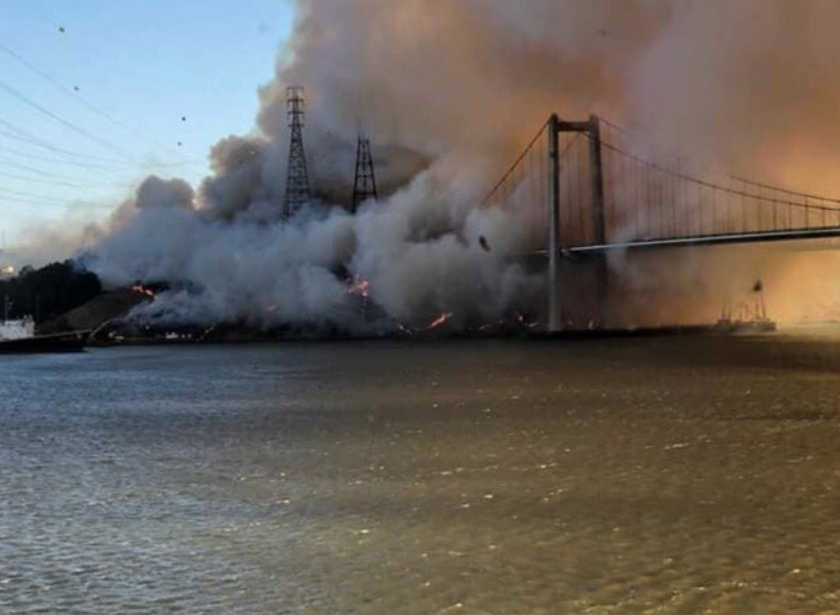
This is true all over the areas they serve. It’s why this year PG&E is aggressively cutting power to areas considered to be at risk when we have conditions of dry weather and strong winds — a common occurrence these days, thanks to climate change. Initially all of our house guests (call them what they are; refugees) were here because power was cut to their homes. But then two of them made a run up to Vallejo to rescue their four cats, because while there hadn’t yet been a mandatory evacuation order issued for their area, there was a “precautionary” evacuation underway. This was why. Fires bracketed Vallejo on three sides. We don’t know yet whether any of them were started by PG&E’s power lines, but the Kincade Fire burning up in Sonoma almost certainly was. Because PG&E may be cutting power to areas . . . but they aren’t necessarily shutting down their main transmission lines. And if your immediate thought is “they should do that!,” be aware that part of the problem in Vallejo yesterday was that PG&E shut off the power to the water-pumping stations. Which makes fighting a fire rather more difficult.
I don’t want anybody to walk away from this thinking PG&E is the sole cause of the fires. If we didn’t have such dry conditions and such high winds, coupled with sporadic wet winters that encourage the growth of new brush which then turns into tinder a few months later, the fires wouldn’t burn as hot and as far; that’s thanks to climate change, and humanity is collectively responsible for that one. And it’s true that for a long time forestry officials thought it was best to prevent all forest fires, whereas now we know it’s actually better for the environment to let (smaller) blazes sweep through periodically to clear things out. We could change our urban planning to put fewer homes and people at risk.
But PG&E unquestionably shoulders some of the blame. And so does the overall corporate culture that encourages short-term thinking, boosting quarterly profits at all costs, deferring expenses again and again so you can look “fiscally responsible” (while someone else pays a heartbreaking bill down the road).
That’s finally, maybe, a little bit, beginning to change. Corporations are starting to admit that maybe shareholder dividends should not be their first, last, and only priority. The new Long-Term Stock Exchange was founded to encourage companies to think on time scales longer than three months. We might — we can hope — eventually see a world where we once again know how to plan for the future, investing in infrastructure and building a world future generations will want to live in.
The road there, however, is currently leading through a burned-out hellscape.


no subject
Date: 2019-10-28 06:10 pm (UTC)no subject
Date: 2019-10-29 05:28 am (UTC)>_<
no subject
Date: 2019-10-28 08:26 pm (UTC)no subject
Date: 2019-10-29 05:30 am (UTC)no subject
Date: 2019-10-29 07:23 am (UTC)no subject
Date: 2019-10-29 03:18 am (UTC)no subject
Date: 2019-10-29 05:32 am (UTC)no subject
Date: 2019-10-29 04:09 pm (UTC)But there's a difference. Bonneville Power Administration aggressively maintains their high voltage transmission lines, and the local utilities, investor-owned and public-owned alike, do the same. The driver here isn't fire--it's big winter windstorms that take down trees, especially early in the season when there's still leaves on the deciduous trees, and ice storms. If you don't keep the trees trimmed and maintained, welp, the next big ice storm is going to knock power out for days to weeks. And given that ice storms are usually preceded by nasty hard east winds that can gust up to 100 mph in places and bring down trees...yeah.